Tuesday, December 15, 2009


Mark Bleier

I visited the Albany Airport art exhibit called “Out of this World.” Before I visited the art exhibit at the Albany Airport, I did not know what to expect. I was amazed to find out how unique and beautiful the exhibit actually was. The name of the exhibit also attracted my attention right away. There were seven artists who showed their art work and each artist had unique art pieces. The seven artists included Betsy Brandt, Susie Brandt, Ginger Ertz, Chris Harvey, Jennifer Maestre, David Miller, and Devorah Sperber. The artists used various materials such as, pom-poms, flowers, spools of thread, pencils, and cloth. At first I was skeptical about the art exhibit because it was in an airport but it exceeded my expectations.
One piece that caught my attention right away was Seven Columns of Commerce and Pleasure by Chris Harvey. The colors and they way it was decorated amazed me. It looks like traditional columns but with wacky colors and made out of bowls. There are seven huge columns which are hard to miss. This art piece gives life to the airport with its colors and size. Another art piece which I liked was Midnight in the Garden of the Sea, by David Miller. This piece really caught my attention because of the way it was constructed. It was a dark sea with bright creatures within the sea. It was hard to make out what the creatures were but they represented bright fish. At first it looks like a bunch of scribbling, but as you look at it you realize how it represents fish and other sea creatures.
I also enjoyed Susie Brandt’s piece called Stumps and Drains series. This piece consisted of bright colored hook rugs which represented rain run-off drains and the top of tree stumps. At first glance I did not realize what the art piece was. But after observing it and discussing it with someone, I knew what it was and could enjoy the beauty of it.
The art piece that I liked the most was Spock 3, by Devorah Sperber. I consists of 1,200 spools of thread. It is a picture of a star wars character which is upside down. In the middle of the picture it has a steel ball chain hanging from it. This picture amazed me the most out of any piece at the exhibit. I thought it was amazing how one big picture could be made out of thousands of little spools of thread.
Overall I thought the exhibit was a great experience. I had the chance to see a lot of great art works. At first I did not think that art exhibit was going to be that good, but after visiting it, it really changed my mind.

Monday, November 16, 2009

Gillian Wearing and Vanessa Beecroft.


Mark Bleier

Gillian Wearing and Vanessa Beecroft are artists who utilize the public when creating their art. They both use random people and objects within the public society to enhance their work. They utilize just about anything in public, such as people, buildings, or general themes. Their work has many similarities that run parallel to one another.
Gillian Wearing is an English conceptual artist who is concerned with examining the details about people. She uses common people in the public to accent her work. One of her first major works was called, Signs that say what you want them to say and not Signs that say what someone else wants you to say. She took a series of random people on the streets and asked them to write something down on a piece of paper. She photographed the random people holding up the piece of paper. There was a police officer who wrote ‘help’ and a person dressed up a casual business suit wrote ‘I’m desperate.’ This piece of work got a lot of recognition and it solidified Wearing as a respectable artist.
Wearing also uses videos in her art works. She once videotaped people’s reaction to a certain advertisement. She wanted their reactions on videotape. She also has a video called Drunk which is four drunk men stumbling around. All of her works have to do with individuals and their behaviors. I enjoy looking at Wearing’s art work. I feel that she encompasses the individual and the public in fun and interesting way. I like her piece on taking random people and telling them to write something on a piece of paper and photographing it. It made me think about what I would write, Even though I have yet to make a decision. I overall enjoy viewing Gillian Wearing’s work. Vanessa Beecroft is an artist who uses mainly performance art to examine individuals
Vanessa Beecroft is an Italian contemporary artist who focuses on individuals in performance art. She uses many nude females within her work. This has created a lot of controversy within her work. One of her first performances included a series of drawings of her Food Dairy. In a recent performance she made one hundred nude women wearing pantyhose; stand in Berlin for three hours. This is an example of why her work is considered controversial. Her work is mainly live, consisting of female models and only recently has she considered males. I feel that her work is a little extreme and should not mainly include nudity. I do not see the message that one hundred nude females standing for three hours is sending. I do not consider that real art. I do however like that she uses the public and individuals within her work. I enjoy art work that encompasses the common citizen within it. It gives the everyday person a chance to participate in the creation of art. I can see why much of her work is seen as controversial.
Gillian Wearing and Vanessa Beecroft are two artists who encompass individuals and the public within their work. I enjoyed viewing Wearing’s work and I enjoyed parts of Beecroft’s. Beecroft’s work is too extreme while Wearing’s is interesting and fun to view.

Mid-Term part 2

Mark Bleier

Performance art is a type of art that is performed live and in front of an audience. The themes are usually on current topics which communicate a specific message. The theme for my performance will be about the environment. The purpose of my performance is to bring attention to, and remind the audience on how badly we are polluting and destroying our environment. The environment is a major topic in today’s society. The “going green” aspect is becoming huge and everyone is becoming more environmentally friendly. Many people are buying Hybrids instead of regular cars and doing everything they can to clean up our environment. I will show the audience numerous pieces of art which bring attention to the horrible things we do to our environment. I will show how everyday activities, which we rarely think about, can affect our environment. I will show the audience through a short PowerPoint presentation. An example of art will be a picture of millions of cell phone batteries, which represent the batteries that are thrown out and pollute our earth daily.
There is going to be green lighting to reflect the environment and also to represent “going green.” I will play a different audio during each slide which corresponds to that specific art piece. This performance will take place in New York City and will be a half hour long. If it is any longer than that, the audience will lose focus. It will also be broken into six parts. I will be the only performer and I will have one person switching slides per my request.
Script
1- Before I come out on stage, I will show a short video clip, showing how badly we are polluting our earth. 3 minutes
2- I will then come out on stage and introduce myself and give the audience background information about myself. I will also explain why I am showing them this presentation.- 2 minutes
3- I will then show my first art piece. It will be a big picture of a plastic grocery bag which will actually be made out of millions of small plastic grocery bags. I will have to zoom-in to show the audience how the big plastic bag is made up of little ones. This will represent the millions of plastic grocery bags that are thrown away and pollute our earth daily. I will give background on how they pollute the earth and why people throw them away. The audio will be the sound of plastic grocery bags when they are touched. It will not be loud because it will distract the audience. 5minutes.
4- My second slide will be a picture of a large cell phone battery. At first glance it just looks like a normal picture of a battery. I will once again zoom-in and show the audience how it is made up of millions of little cell phone batteries. This will represent the millions of wasted cell phone batteries, which are thrown away and pollute the earth daily. I will explain how easy it is for people to just throw away their batteries out the window or in the garbage. I will also explain why the materials in the cell phone batteries are hazardous to the environment. The audio will be the sound of a cell phone ringing. It
5- My third and final slide will be a picture of a Coca-Cola can. At first glance, it will look like a typical can of cola. I will once again zoom-in and show the audience how it is made up of millions of little Coca-Cola cans. These can represent the non-recycled cans that pollute our earth every day. I will stress the importance of recycling and show how something as simple as recycling can help our environment. The audio will be the sound of a can when it drops into a bin. 5minutes.
6- I will then thank the audience for watching and do 10 minutes of question and answering. I will also give them my contact information.

Tuesday, November 3, 2009

Reaction to Dave Hickey's lecture

Mark Bleier

Dave Hickey delivered a humorous and effective art lecture about selling without selling out. He explained how people are becoming too infatuated with the price of the art and not the beauty of art. Art works are becoming too expensive and in return, it is diminishing the meaning of real art. Real art should not encompass an outrageous sum of money, which is created by the transaction of the buyer and seller. Unfortunately, artists mostly develop their work with prices and money on their mind.
The art market place has drastically changed from the transition into the twenty first century. In the twentieth century the art market place was a ‘finite market place,’ which means that there was always more works of art than there were people to buy them. That is not the case today. People are buying numerous pieces of art at a time. I feel that this is becoming a big problem. People have forgotten the real meaning of art and cannot even look at an art piece without wondering the price of it. Artist should go back to creating and showing art that they actually believe in, instead of creating art for the money and collectors. Art in supposed to be fun and not concentrated on money and capital gain. Hickey also states that the art world consists of greedy artists and stupid collectors and these are the people who get hurt. Greedy artists and stupid collectors is exactly what negatively affecting the art world today. When I listened to that, it really occurred to me how ridiculous the art market is becoming. People need to stop worrying about the price of art and start enjoying the beauty of it.

Dave Hickey’s lecture is similar to the documentary on the “Mona Lisa Curse,” by Robert Hughes. The Mona Lisa Curse outlines how the art world in too consumed with money and prices. The Mona Lisa created an art market which is capitalistic and commercialized. Collectors buy any type of art work that they can get their hands on and I feel that it is ruining art within galleries and museums. The art market is not even about the art anymore, it is about how much money the seller can make off the buyer. Collectors do not need hundreds of art works, but they feel they do in order have bragging rights. Hickey talks about how there is an abundance of money is circulating in the world and jokes that it is hard to get your hands on some without selling art. Art has become too capitalistic as means for collecting money.

I think that Dave Hickey delivered an interesting and influential lecture on art. All the arguments that he made, I agreed with. The art market has changed throughout the years and it became mostly about money. Art is now about selling to the collectors and the consumers.

Wednesday, October 21, 2009

Part 1 Mid-Term

Mark Bleier
Part 2 of Mid-Term

Marcel Duchamp has a tremendous impact on the art world and he affects the way many artists chose to do their work. As I read The Duchamp Effect, I realized how he affects artists and conceptual art today. Duchamp has most definitely left behind a strong influencing legacy.
Marcel Duchamp was considered a rebel and was “against a kind of academic slavery that artists went through who followed a traditional path” (55). He liked his art work to be extreme and different. Duchamp was a conceptual artist who did not like to paint. He made the most common objects, a piece of art. He paved a path for many conceptual artists. He showed artists that there is another way of looking at art. His conceptual art influenced many artists, and still does today. Ed Ruscha is an American artist who is influenced by Duchamp’s work. He states that Duchamp is “a part of my history and my art” (55). Ruscha’s work is similar to Duchamp’s, in that Ruscha uses common objects and words as art also. He would use a common object such as the word ‘noise’ and make that an art piece.
Bruce Connor is another American artist who is influenced by Duchamp’s legacy. Connor said that he made an art piece that was in response to Duchamp. Connor explained that he “attempted to do collaboration at the Charles Alan Gallery in New York after Duchamp had shown his Roto Reliefs at the gallery” (59). Connor’s art work is also similar to Duchamp’s. The article shows pictures of both artists work and they look similar. Connor’s ‘The Bride’ is a picture of a still object. Duchamp’s ‘travelling box’ is also a picture of a still object.
Sherrie Levin is another artist who is influenced by Duchamp’s conceptual art work. She took a picture of an ordinary pair of shoes and made it a brilliant piece of art. She said it was very “Duchampian the idea of taking the original readymade and making it into a fabricated readymade” (177). Levine also said that Duchamp provided her with a way to make sculptures, which she makes very well. When she sculpted, she thought “primarily about Duchamp” (179). Levin’s artwork, After a Broken Leg, is referring to Duchamp because it used a practical object and made it art.
Louise Lawler is an artist whose art “continually pushes at the edges” (184). Duchamp’s work also pushed the edges especially ‘The Fountain.’ Lawler’s use of shadows is also something Duchamp used. Fred Wilson is a conceptual artist who focused on how the “museum is assembled and how meaning is constructed in that context” (187). Duchamp, as a contemporary artist, was also focused on art and the museum. Wilson wants to create “a sense of shock” with his art. Duchamp also wanted his work to be a surprise to the viewer.
All the five artists mentioned have been influenced by Duchamp’s conceptual art style. Duchamp’s artistic effect caused the artist to realize how to look at and create new types of art. There are similarities in these artists’ works. They all learned to look at art in different way and they all incorporate common objects within their work. Duchamp questioned art and the nature of it and that is noticeable in these artists work.


The Duchamp Effect. Essays, Interviews, Round Table. Edited by Martha Buskirk and Mignon Nixon.

Tuesday, September 29, 2009

Suzi Gablik and Jospeh Beuy

As I read the two essays, I found “I like America and America Likes me,” by Joseph Beuys, a little strange. After I read about his personality and personal life, I found his work less strange because he was a strange man himself. I found “The Nature of Beauty in Contemporary Art,” by Suzi Gablik, a little less strange and easier to understand and follow.

As I researched Joseph Beuys, I found that he had a close relationship with all kinds of wild animals. He followed beavers, horses, coyotes, and wolfs. He even once considered himself an animal. Beuys was once a combat pilot in war and after reading that I can see why he names a part in his essay “The Coyote War.” He talks about the Vietnamese war and how coyotes are being hunted. Beuys has a connection with animals and that is why he is bringing attention to them. Joseph Beuys’ work is a bit strange and I attribute that to his life. He has had a very traumatic and weird life, from being captured in war, to his fascination with animals. “I Like America and America Likes Me” is strange and difficult to understand. I understand this piece to ultimately bring attention to animal’s rights and a reflection of his personal life.

Suzi Gablik’s essay is easier to comprehend and has lot of intelligent and useful pointers about art. She explains how more and more artists are starting to use public placed for their art. Using public places involves more people and can be seen by more people. It can also send a political or moral message to the public. I think that the new public art is the most interesting and influential. Artists, who use the public for their art, should send an important message. Whether it is raising an environmental problem or raising awareness on another social problem, public art is influential and seen by many people. I have personally seen public art which raise awareness about some type of environmental problem. An artist put millions of cell phone batteries together to represent all the wasted batteries which pollute our earth yearly. This type of art is interesting and knowledgeable. I have also seen a public art piece made out of millions of plastic grocery bags which are wasted and pollute every day.

Suzi states that she wants to bring “art back into a more vernacular everyday world, and take it out of the more rarefied sphere of professionalism.” I agree with this because art has always been private and in the studio in which it was made. Art in the public is seen by more people and can influence more people’s lives. I agree with all that Suzi Gablik said in her short essay. Art should become more public in the social, political, and environmental life.

I took a lot from Suzi Gablik’s short essay about art. I agree with her work and her reasoning. Although it was hard to interpret and understand Joseph Beuy’s essay, I still found it interesting and fulfilling.

Tuesday, September 22, 2009

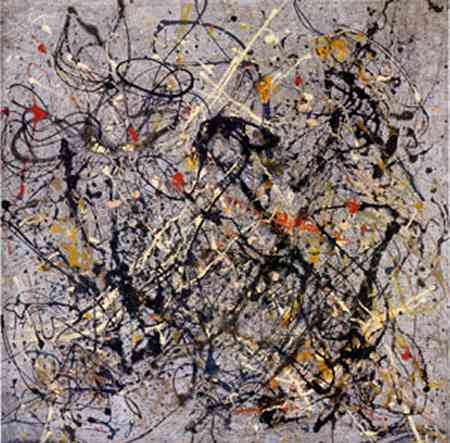
Jackson Pollock 9/24


I chose to research Jackson Pollock's painting Number 18. Before researching him and his painting style, I thought of this painting as rather odd. At first glance it looks as if he did the painting in about twenty minutes. It looks like a bunch of scribbling on a piece of paper. I didnt quite understand the meaning of this painting and why he painted this way. After researching him and his painting style, I found that he developed a new type of art called "drip painting," and this became his technique throughout his painting career. Number 18 was painted in 1950 by the American painter, Jackson Pollock. I also found that he was not particularly good at drawing, so this is his alternative to painting and drawing. This lack of drawing skills led to him developing this drip painting.


As I looked at Number 18 more and more times, I began to see how much effort it actually took him to paint this. These paintings would take him weeks to develope and not just twenty minutes, as was my first impression. When Pollock made these type of paintings, it was a way for him to express himself without drawing. He made this "Drip Art" extremely popular and is famous worldwide for it. After researching Jackson Pollock and his Number 18 painting, I now know why he painted that way and also how much effort really went into his effortless looking paintings.