As I read the two essays, I found “I like America and America Likes me,” by Joseph Beuys, a little strange. After I read about his personality and personal life, I found his work less strange because he was a strange man himself. I found “The Nature of Beauty in Contemporary Art,” by Suzi Gablik, a little less strange and easier to understand and follow.
As I researched Joseph Beuys, I found that he had a close relationship with all kinds of wild animals. He followed beavers, horses, coyotes, and wolfs. He even once considered himself an animal. Beuys was once a combat pilot in war and after reading that I can see why he names a part in his essay “The Coyote War.” He talks about the Vietnamese war and how coyotes are being hunted. Beuys has a connection with animals and that is why he is bringing attention to them. Joseph Beuys’ work is a bit strange and I attribute that to his life. He has had a very traumatic and weird life, from being captured in war, to his fascination with animals. “I Like America and America Likes Me” is strange and difficult to understand. I understand this piece to ultimately bring attention to animal’s rights and a reflection of his personal life.
Suzi Gablik’s essay is easier to comprehend and has lot of intelligent and useful pointers about art. She explains how more and more artists are starting to use public placed for their art. Using public places involves more people and can be seen by more people. It can also send a political or moral message to the public. I think that the new public art is the most interesting and influential. Artists, who use the public for their art, should send an important message. Whether it is raising an environmental problem or raising awareness on another social problem, public art is influential and seen by many people. I have personally seen public art which raise awareness about some type of environmental problem. An artist put millions of cell phone batteries together to represent all the wasted batteries which pollute our earth yearly. This type of art is interesting and knowledgeable. I have also seen a public art piece made out of millions of plastic grocery bags which are wasted and pollute every day.
Suzi states that she wants to bring “art back into a more vernacular everyday world, and take it out of the more rarefied sphere of professionalism.” I agree with this because art has always been private and in the studio in which it was made. Art in the public is seen by more people and can influence more people’s lives. I agree with all that Suzi Gablik said in her short essay. Art should become more public in the social, political, and environmental life.
I took a lot from Suzi Gablik’s short essay about art. I agree with her work and her reasoning. Although it was hard to interpret and understand Joseph Beuy’s essay, I still found it interesting and fulfilling.
Tuesday, September 29, 2009

Tuesday, September 22, 2009
Jackson Pollock 9/24
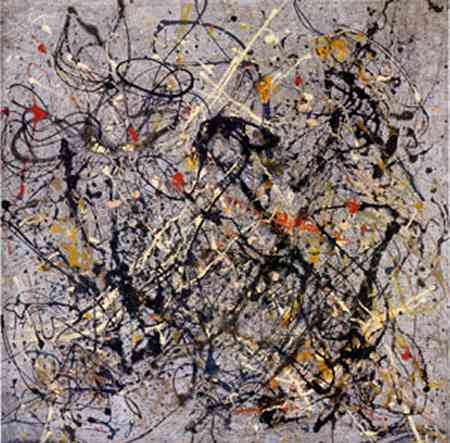
I chose to research Jackson Pollock's painting Number 18. Before researching him and his painting style, I thought of this painting as rather odd. At first glance it looks as if he did the painting in about twenty minutes. It looks like a bunch of scribbling on a piece of paper. I didnt quite understand the meaning of this painting and why he painted this way. After researching him and his painting style, I found that he developed a new type of art called "drip painting," and this became his technique throughout his painting career. Number 18 was painted in 1950 by the American painter, Jackson Pollock. I also found that he was not particularly good at drawing, so this is his alternative to painting and drawing. This lack of drawing skills led to him developing this drip painting.
As I looked at Number 18 more and more times, I began to see how much effort it actually took him to paint this. These paintings would take him weeks to develope and not just twenty minutes, as was my first impression. When Pollock made these type of paintings, it was a way for him to express himself without drawing. He made this "Drip Art" extremely popular and is famous worldwide for it. After researching Jackson Pollock and his Number 18 painting, I now know why he painted that way and also how much effort really went into his effortless looking paintings.
Tuesday, September 15, 2009
Reaction to Fred Ross and Clement Greenberg's articles
After reading the two pieces of writings, I agree that a work of art is "the selective recreation of reality for the purpose of communicating some aspect of what it means to be human or how we perceive the world" (Ross, 1). I feel that a work of art must convey meaning and make the viewer really think about it. The best types of art relate to real life, by either real pictures or conveying real human emotion. I also agree that the best art are "things that we might experience in reality, and that actually have an aesthetic effect" (Ross 1).
I feel that great pieces of art should be more than just lines, colors, and paint. It should convey some sort of meaning that relates to the viewers. I like when Ross states that "it is an artist, a human being, who is doing the selecting- not nature and not chance." Real art should touch the viewer on an emotional level. It should reflect on the human being and the adventures or stories that come with it. I think Ross sums up real art when he says "real art communicates or expresses compelling stories about the odyssey of human life; all the leagues it has traveled, all the lands it has visited" (Ross 2). When artists just paint with no meaning or emotion, its not enjoyable for me. It is not real art when "people splash paing on a canvas in pretty patterns, or brushing it on in aesthetically pleasing color combinations" (Ross 3).
Although I agree with Ross's arguments, I also agree with some of Greenbergs comments. I understood Ross's points more clearly but I agree with some parts of Greengergs. I agree that real art can also represent literature. Some of the best paintings of the 17th and 18th century came from literature. I also agree with Greenberg when he states that "everything depends on the anecdote or the message" (Greenberg 29). The message that is being recieved by the viewer is very important. I also agree that music can be an art. Music touches people on an emotional level, and making music art can be interesting. Music can produce a kind of art that is in "pure form" (Greenberg 31). Even though some music can be considered art, I still feel that real art should be a sort of painting with emotions or feelings.
Greenberg offers poem as a type of art. He agrues that poetry offers "Possibilities of meanings." I do not agree because although poems can provoke a type of emotion, poems require you to read and art should just require you to observe. That may seem sort of lazy but that is how I view great art. Poerty requires a reader and real art only requires a viewer.
My opinion is that real art should be based on real life, communicating some sort of meaning to the viewer. It should also provoke some sort of emotion and make the viewer think. If an art piece grabs real human emotions, I think its real art.
I feel that great pieces of art should be more than just lines, colors, and paint. It should convey some sort of meaning that relates to the viewers. I like when Ross states that "it is an artist, a human being, who is doing the selecting- not nature and not chance." Real art should touch the viewer on an emotional level. It should reflect on the human being and the adventures or stories that come with it. I think Ross sums up real art when he says "real art communicates or expresses compelling stories about the odyssey of human life; all the leagues it has traveled, all the lands it has visited" (Ross 2). When artists just paint with no meaning or emotion, its not enjoyable for me. It is not real art when "people splash paing on a canvas in pretty patterns, or brushing it on in aesthetically pleasing color combinations" (Ross 3).
Although I agree with Ross's arguments, I also agree with some of Greenbergs comments. I understood Ross's points more clearly but I agree with some parts of Greengergs. I agree that real art can also represent literature. Some of the best paintings of the 17th and 18th century came from literature. I also agree with Greenberg when he states that "everything depends on the anecdote or the message" (Greenberg 29). The message that is being recieved by the viewer is very important. I also agree that music can be an art. Music touches people on an emotional level, and making music art can be interesting. Music can produce a kind of art that is in "pure form" (Greenberg 31). Even though some music can be considered art, I still feel that real art should be a sort of painting with emotions or feelings.
Greenberg offers poem as a type of art. He agrues that poetry offers "Possibilities of meanings." I do not agree because although poems can provoke a type of emotion, poems require you to read and art should just require you to observe. That may seem sort of lazy but that is how I view great art. Poerty requires a reader and real art only requires a viewer.
My opinion is that real art should be based on real life, communicating some sort of meaning to the viewer. It should also provoke some sort of emotion and make the viewer think. If an art piece grabs real human emotions, I think its real art.
Monday, September 14, 2009
Perfect piece of art

Title of Piece-The Three Dancers
Artist- Pablo Picasso
Nationality of artist- Spanish
Year-1925
Pablo Picasso is considered one of the greatest artists ever, so I chose one of his paintings to represent a Perfect piece of art. The Three Dancers has meaning behind it, it makes the viewer think, there is distinct styles to it, and it represents a time period of the 1920's. This painting contains many traits that are represented is perfect pieces of art.
Subscribe to:
Comments (Atom)